
Pricing
PSA Grading Cost in 2026: Is Grading Worth It? Do the Math
Every PSA tier and fee, plus real eBay sold prices for PSA 7 to PSA 10 cards, so you know whether grading pays before you send it in.
PSA's cheapest open tier now costs $39.99 per card before shipping. A $15 card has to climb a steep hill to pay for that. The real test is what the graded card sells for after every cost. So what does PSA grading cost in 2026, and is it worth it?
Quick Answer: How Much Does PSA Grading Cost?
PSA charges $39.99 to $599 per card on its open tiers, based on the card's declared value and your speed. Add shipping both ways, supplies and eBay's 13.25% card fee. Grading only pays when the graded sold price beats the raw price plus all of those costs, which cheap cards rarely manage.
Here are the tiers, the hidden costs and the break-even math.
Key Takeaways
- Entry price: PSA's Value tier is $39.99 per card with a 90 to 100 business day estimate.
- Most cards shouldn't be graded: Of 591 trading card sales by FlowLister sellers, 87% sold for under $20.
- Low grades lose money: 44% of PSA 7 sales and 34% of PSA 8 sales on eBay went for under $30.
- PSA 10 carries the profit: The median PSA 10 sold for $153.75 against $74.99 for a PSA 9.
- Run the formula first: Graded sold price minus raw sold price minus every cost. If it's negative, sell the card raw.
Let's start with the tiers.
How Much Does PSA Grading Cost in 2026?
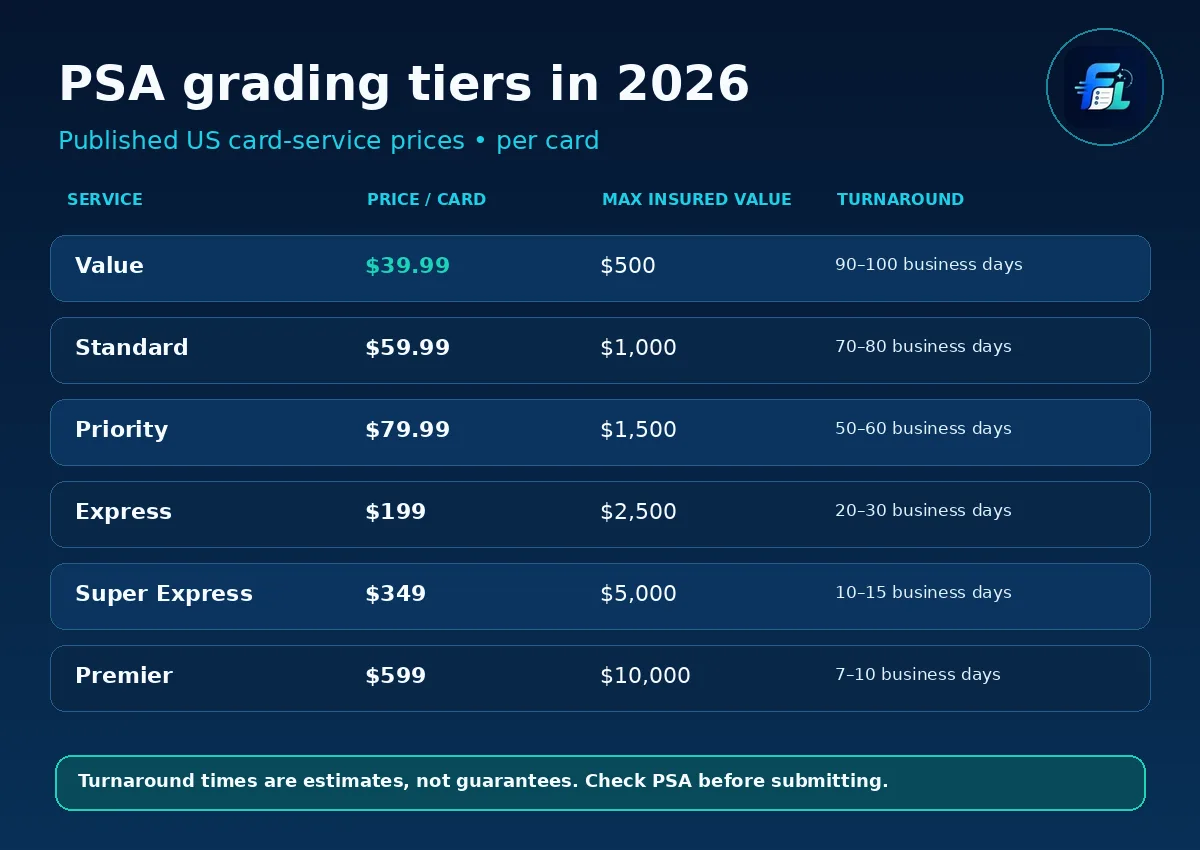
PSA prices by service level and each level caps the card's insured value. Faster service costs more. These are PSA's published prices for new submissions.
| Service level | Price per card | Max insured value | Estimated turnaround |
|---|---|---|---|
| Value | $39.99 | $500 | 90 to 100 business days |
| Standard | $59.99 | $1,000 | 70 to 80 business days |
| Priority | $79.99 | $1,500 | 50 to 60 business days |
| Express | $199 | $2,500 | 20 to 30 business days |
| Super Express | $349 | $5,000 | 10 to 15 business days |
| Premier | $599 | $10,000 | 7 to 10 business days |
- Estimates, not promises: PSA says turnaround times are estimates, not guarantees and can change with volume.
- Prices move: PSA reopened Value on October 29 and raised several prices. Check the live pricing page before you submit.
- Higher tiers exist: PSA also lists tiers above Premier for very high-value cards.
Which Tier Should You Pick?
Pick the lowest tier whose cap covers the card's value. Speed costs real money, so only pay for it when the card's price is moving.
- Under $500: Value is the cheapest open way in. You pay in time, not dollars.
- $500 to $1,500: Standard or Priority, depending on how long you can wait.
- Over $1,500: Express and above start at $199 per card. That only makes sense for cards worth far more.
Before you run the numbers, our guide to eBay final value fees shows what comes off the top of every sale.
The Costs People Forget
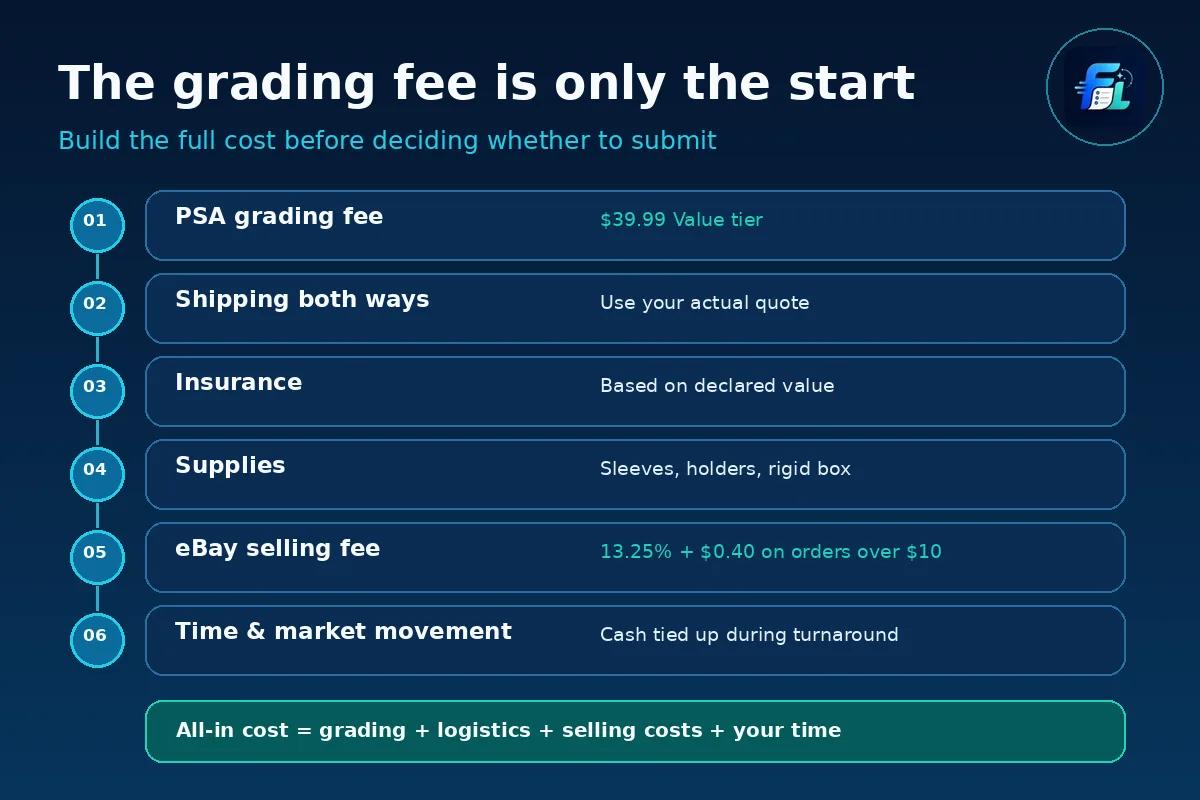
The grading fee is the headline. Shipping, insurance, supplies and eBay's cut change the answer.
- Shipping both ways: You pay to send cards in and you pay for the return trip. Get a real quote for your order.
- Insurance: Insure the package at the value you declare.
- Supplies: Penny sleeves, semi-rigid holders and a rigid box add a few dollars.
- Tier mismatch: A card worth more than a tier's cap belongs in a higher tier. The difference comes out of your pocket.
- eBay fees: eBay charges 13.25% of the sale on trading card categories up to $7,500, plus $0.40 per order over $10.
- Time: A 90 day wait ties up cash and the card's price can move.
Here's what that stack looks like on a single card. Say a card sells for $100 after grading. eBay takes $13.65 ($13.25 plus the $0.40 order fee). That leaves $86.35 before the grading fee, shipping and the price you could have gotten raw. Those numbers are why we run the formula before every submission.
What PSA Graded Cards Actually Sell For on eBay
A PSA 10 median sold price is $153.75 on eBay. A PSA 7 median is $32.83. The gap explains why grade decides everything.
| Grade | Sales | Median sold price | Sold under $30 |
|---|---|---|---|
| PSA 10 | 1,130 | $153.75 | 7% |
| PSA 9 | 1,001 | $74.99 | 24% |
| PSA 8 | 293 | $49.00 | 34% |
| PSA 7 | 84 | $32.83 | 44% |
Source: FlowLister's sold-comp database of eBay sold listings, pulled Nov 22, 2026.
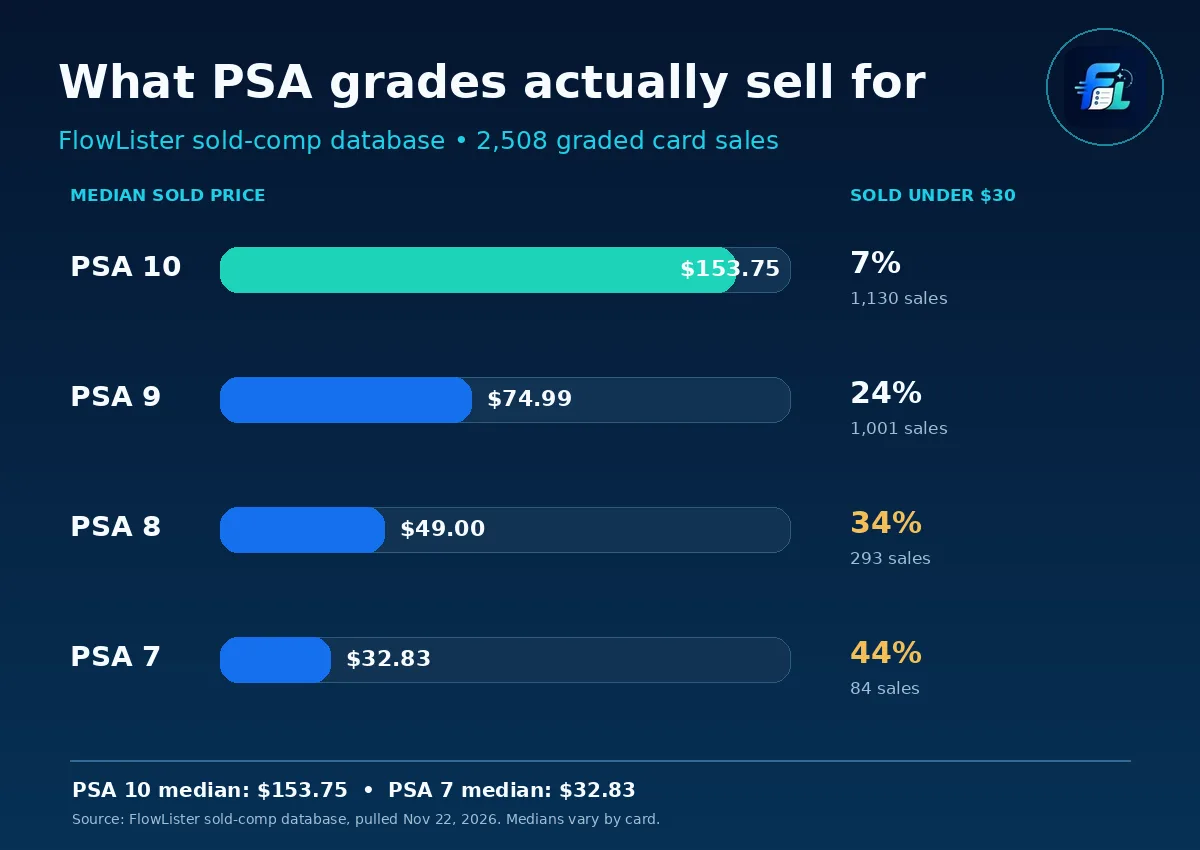
These are medians across all cards so your specific card could sit well above or below them. The pattern still holds. Once you add the grading fee and shipping both ways, a big share of PSA 7 to 9 cards sell for less than they cost to grade.
Cheap cards make it worse. FlowLister sales data shows 87% of 591 trading card sales by FlowLister sellers were under $20. Most cards should never be graded.
Is PSA Grading Worth It? The Break-Even Formula
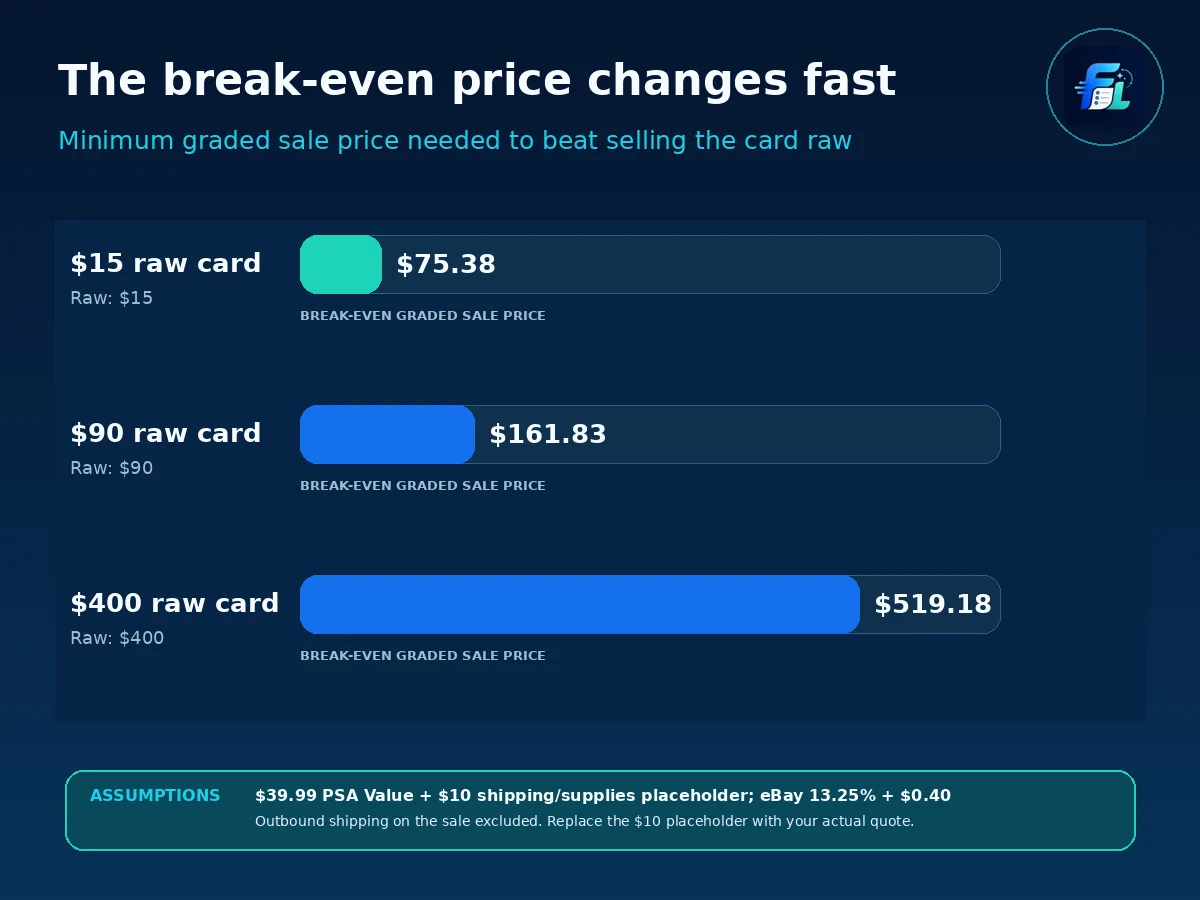
Grading is worth it when the graded sold price beats the raw sold price plus all costs. The formula is simple and the answer is often no.
Profit = graded sold price minus eBay fees minus raw sold price minus grading fee minus shipping and supplies.
We'll use the Value tier ($39.99) and assume $10 for shipping both ways and supplies. That's a placeholder, so swap in your real quote. eBay fees use 13.25% plus $0.40. Outbound shipping on the sale is left out, which makes real results slightly worse.
| Raw card sold price | Total grading cost | Graded price needed to break even |
|---|---|---|
| $15 | $49.99 | $75.38 |
| $90 | $49.99 | $161.83 |
| $400 | $49.99 | $519.18 |
Example 1: A $15 Raw Card
You need a graded sale of $75.38 to break even. A PSA 10 at the $153.75 median would net about $67.99. A PSA 9 at $74.99 loses about $0.34. A PSA 8 loses about $22.88. A PSA 7 loses about $36.91. Only a 10 clears it so your odds of a perfect grade matter more than the card.
Example 2: A $90 Raw Card
You need $161.83. Even the $153.75 PSA 10 median falls $7.01 short. A PSA 9 at the median loses about $75.34. Grade this one only if your card's own PSA 10 comps sit clearly above $162.
Example 3: A $400 Raw Card
You need $519.18. No grade's median gets close, so use this card's own sold comps instead of the table. The $400 value fits Value's $500 cap. If PSA 10 copies of your exact card sell well above $519, grading can pay.
How to Check Your Own Card
Search the card on eBay and filter to sold listings. Compare raw sales against PSA 9 and PSA 10 sales of the same card. Use the lower of the recent prices, not the best one you remember. Then plug both numbers into the formula above, and decide before you pay for anything.
For hunting those comps, see our walkthrough on finding sold prices on eBay.
PSA vs BGS vs SGC vs CGC on Cost
PSA is not the cheapest grader. Whether its price pays off depends on resale, so compare entry price against what the graded card sells for.
| Grader | Entry price per card | Notes |
|---|---|---|
| PSA | $39.99 (Value) | 90 to 100 business days, $500 max insured value |
| Beckett (BGS) | $14.95 base, $17.95 with subgrades | 75+ days on the base tier, Standard $34.95 |
| SGC | $50 | SGC raised its lowest tier from $15 on Sept 2, 2026 (check gosgc.com for the live price), 40+ days |
| CGC | $17 (Bulk, 25 card minimum) | Economy $20 up to $1,000 value, Standard $55 |
- Cheap isn't always better: A lower fee only helps if buyers pay similar money for the slab.
- Check live pages: Beckett, SGC and CGC changed prices several times in 2026.
Resale value isn't a fee, so it won't show up in a price table. Look at sold comps for the same card in each grader's slab. If the gap is smaller than the fee difference, the cheaper grader wins on profit.
How to List a Graded Card on eBay
When you list eBay trading cards, a graded card needs the grader, grade and cert number in the title and item specifics. Buyers search by those exact terms.
- Title format: Year, brand, set, player, card number, parallel, then grader and grade, such as "PSA 10".
- Item specifics: Fill in professional grader, grade and certification number so filters find you.
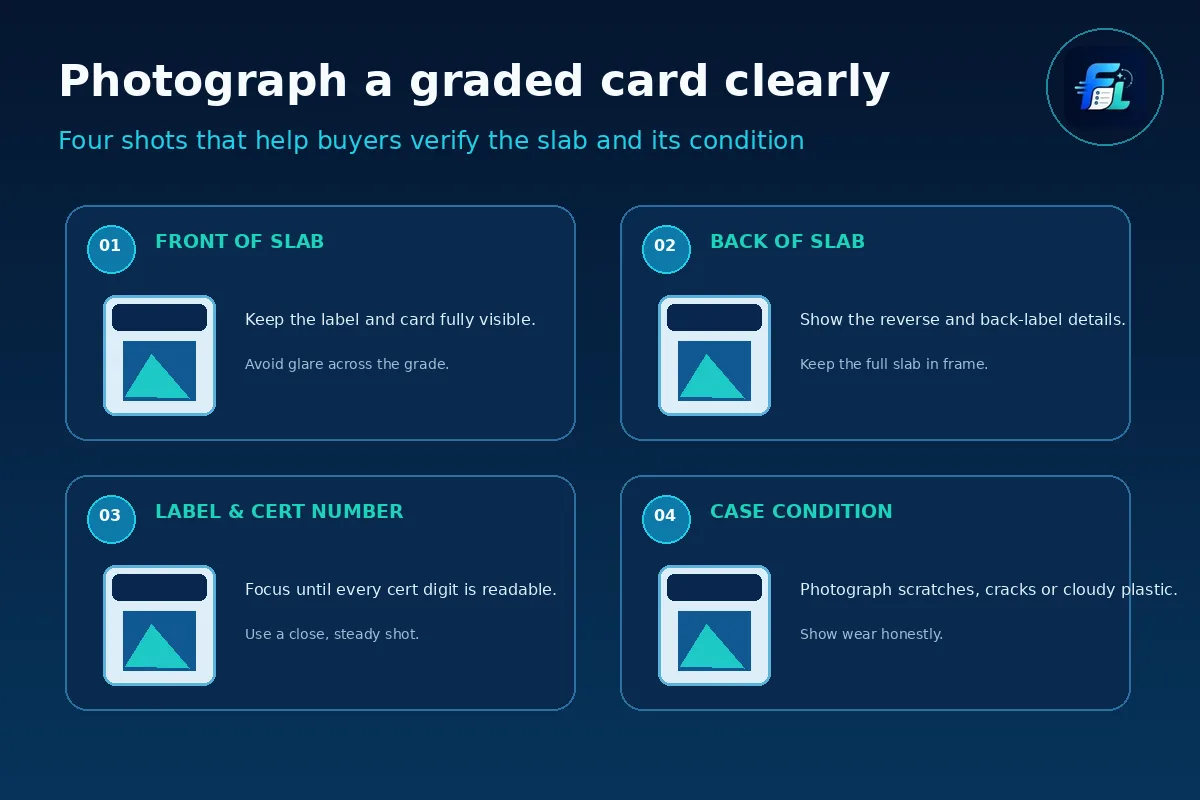
- Photos: Front and back of the slab, plus a close shot of the label and cert number.
- Authenticity Guarantee: eBay's program covers single trading cards priced at $200 and above and it includes graded cards. You ship to an authenticator before the buyer gets it.
- Shipping: Graded cards are not eligible for eBay Standard Envelope, so plan a rigid package.
Photo Checklist for a Slab
Glare kills slab photos. Shoot at a slight angle so the label stays readable.
- Front of the slab, full frame.
- Back of the slab.
- Close-up of the label with the cert number sharp.
- Any case scuffs so the condition matches what you describe.
How FlowLister Lists a Graded Card
FlowLister builds the listing from your slab photos. Then it prices against graded sold comps instead of raw ones.
- Graded comps: The suggested price comes from graded sales when it finds a match and it says so when it doesn't.
- Your notes win: Anything you type overrides what the AI read from the image.
Check FlowLister's features for the current list.
FAQ
How Long Does PSA Grading Take?
PSA estimates 90 to 100 business days on its Value tier and 7 to 10 on Premier. Those are estimates, not guarantees, and PSA has paused and reopened tiers before. Check the live pricing page before you plan around a date.
Can You Grade Just One Card?
Yes. PSA prices per card, so you can submit a single card. Shipping and supplies cost about the same for one card as for ten, which makes a lone card the most expensive per card. Confirm any minimums at checkout.
What's the Cheapest Way to Grade With PSA?
Use the Value tier at $39.99 and send several cards in one package so shipping splits across them. Submit only cards likely to grade high enough to clear the break-even price, since a low grade can cost more than it earns.
Does a PSA 10 Always Sell for More?
No. The median PSA 10 sold for $153.75, yet 7% sold under $30. A PSA 10 of a low-demand card can still lose money after grading, shipping and eBay fees, so check graded sold comps for your exact card first.
Run the Numbers Before You Grade
Grading is a bet on a number, so do the math before you pay. The PSA grading cost is only the start. Add shipping both ways, supplies and eBay's card fee, then compare the total against what your exact card sells for raw. In our sold-comp data, the median PSA 10 cleared that bar on a $15 card but missed it on a $90 card, and lower grades lost money in both cases.
We think most cards should stay raw. Grade the few with strong PSA 10 comps and a real chance of landing that grade, then sell the rest as they are. A quick raw sale often beats a slow gamble on a grade you can't control.
Track your results as you go. Note the grade you expected and the grade you got. After a few submissions you'll know how well your eye matches PSA's, which tells you how much to trust the next break-even calculation.
When a card passes the break-even test, try FlowLister for $0.99 and get it listed.
Written by Chris Taylor, founder of FlowLister, who has sold on eBay since 2020.