
Reselling
Storage Unit Auctions: How to Buy One and Profit on eBay
How storage unit auctions work, how to set a max bid, and what to list first. Based on 24,141 real eBay sales by FlowLister sellers.
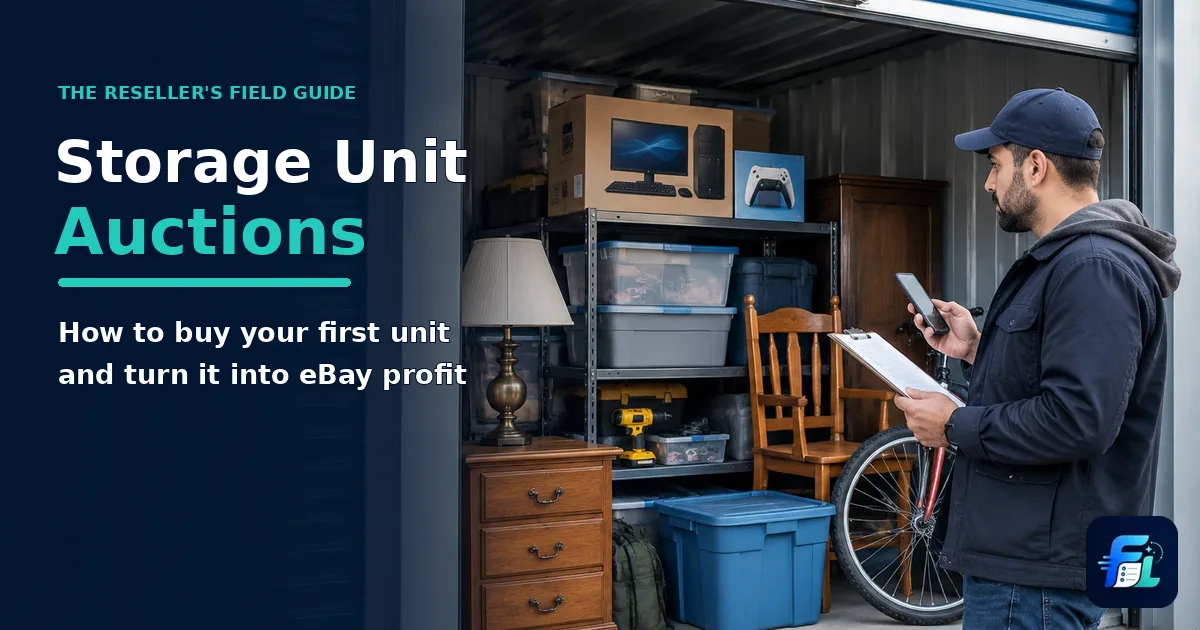
About 11% of US households rent a storage unit, according to the Self Storage Association's 2023 demand study. Some tenants stop paying and the facility sells the contents to the highest bidder. So how do storage unit auctions work, and can you really turn a unit into eBay profit?
Quick Answer: How Do Storage Unit Auctions Work?
A facility sells a delinquent tenant's unit as one lot after following its state lien law. You bid on what you can see from the doorway, pay the price plus buyer fees and any deposit, then clear everything out within a day or three. Your profit depends on the bid, the fees, the cleanout work and what actually sells.
Here's the full path, from finding a sale to listing your first item.
Key Takeaways
- You buy everything: The unit sells as one lot so the junk comes with the good stuff and you pay to haul it.
- Fees stack up: Online platforms add a buyer's premium of 10% to 15% and many auctions want a refundable cleanout deposit.
- The clock is short: Expect 24 to 72 hours to empty the unit.
- Electronics sell fast: In FlowLister sales data, computers sold in a median 5.5 days and video games in 5.9 days.
- Cards and antiques sit: Sports memorabilia and cards took a median 34.5 days. Antiques took 25.5.
Let's start with how the sale itself works.
How Do Storage Unit Auctions Work?
A storage facility can sell a unit's contents once rent goes unpaid and it has followed the lien process in its state's law. Bidders then compete for the whole unit as a single lot.
- Why they happen: Auctions follow unpaid rent, and Extra Space Storage describes them as a way to recover what's owed after other collection efforts fail.
- State law sets the rules: Notice requirements differ by state. In Texas, for example, the facility must publish a legal notice in a local paper for two consecutive weeks or post notice at the facility and nearby spots. Arizona and California have their own statutes, so read yours.
- Tenants can still redeem: Lockerfox says a tenant can pay the overdue balance before the sale, which cancels the auction. That's the most common reason sales get pulled.
- No cherry-picking: StorageTreasures warns that partial cleanouts aren't allowed. Everything leaves or your account can be suspended.
Live Auctions vs Online Auctions
Live sales use an auctioneer at the facility. Online storage unit auctions run on a website with doorway photos and a countdown clock. Both sell the lot as-is.
| Live auction | Online auction | |
|---|---|---|
| Viewing | You look in from outside the unit | Doorway photos only |
| Bidding | Auctioneer calls out bids | Timed bids, proxy bids allowed |
| Typical extras | Registration, refundable deposit | Buyer's premium, deposit, possible sales tax |
| Closing | Hammer falls | Soft close: a late bid resets the timer |
If you want to know which purchases cost resellers the most, our breakdown of the most expensive eBay sourcing mistakes is worth a read before your first bid.
Where to Find Storage Unit Auctions (Online and In Person)
Facilities advertise sales through public notices and online platforms. You can find them by calling local facilities, searching platform maps or watching legal notices.
- Facility websites and managers: Extra Space says facilities advertise through public notices such as a local newspaper or an online platform. Ask managers to put you on a call list.
- Online platforms: Lockerfox lets you search by map or distance from your zip code. StorageTreasures runs a similar marketplace.
- Distance limits: New Lockerfox bidders face a distance cap until they've won and picked up units. That's fine. Close units cost less to haul.
- Local legal notices: In many states the law requires newspaper or posted notice, so classifieds still list sales.
Pick auctions close to home. A second trip for a full truck can wipe out the margin on a thin unit.
What to Ask Before You Register
A five-minute call saves you from surprises on auction day. Ask the facility or read the platform's terms for each of these.
- Who can bid: Extra Space requires bidders to be 18 or older with a valid government ID.
- Payment type: Cash only, card only or both. Public Storage warns that methods vary.
- Deposit: Whether there's a refundable cleanout deposit and how much.
- Deadline: How many hours you get to empty the unit and the facility's open hours.
- Extras: Sales tax, buyer's premium and any registration fee.
How to Read a Unit Before You Bid
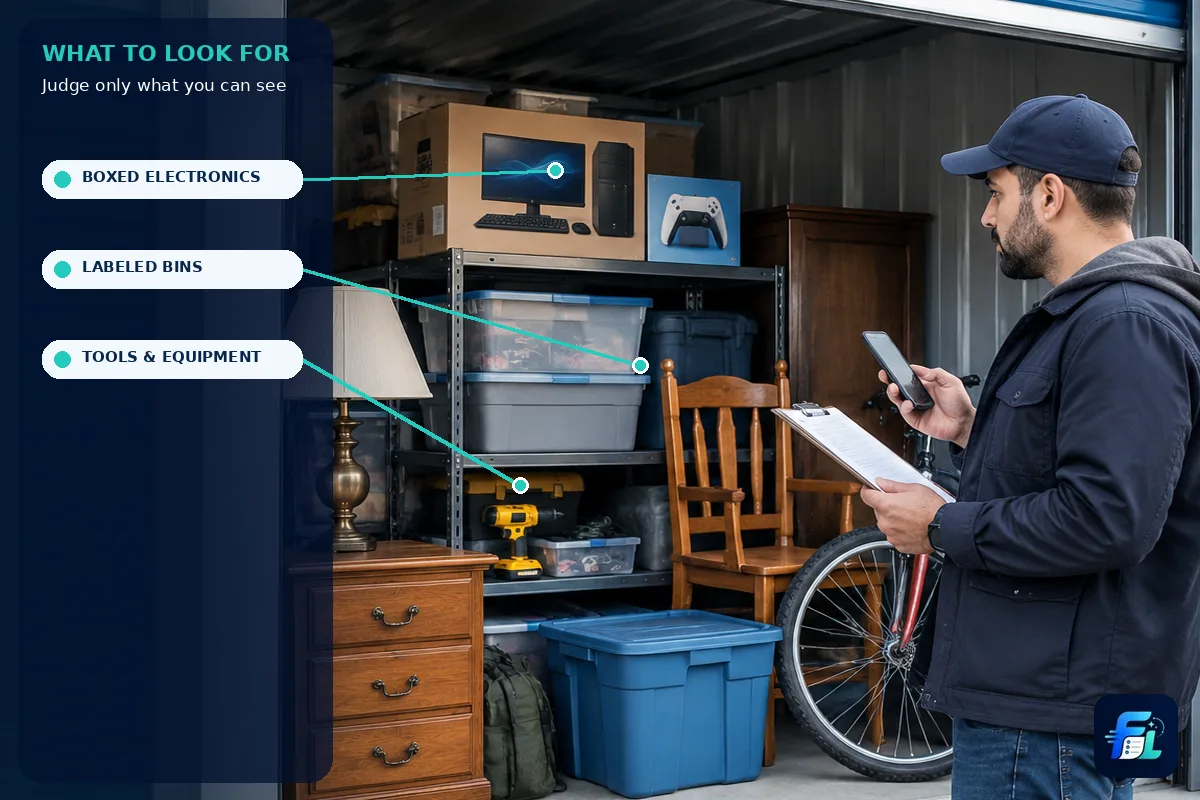
You can't enter the unit or open boxes. You judge it from the doorway or from photos so you're pricing what's visible and guessing at the rest.
- No entry: Public Storage says bidders usually can't enter the unit, move items or open boxes.
- Recognizable items pull bids up: Extra Space notes that furniture, appliances and tools tend to push bids higher, while cluttered units draw less.
- Trash looks like trash: Lockerfox's advice is blunt: bid only on what you can see.
- Vehicles are different: Titles can be tricky, and the process varies by state, so ask the facility before you bid on one.
What to Look For
Look for stacked, labeled bins, electronics in original boxes, tools, sealed totes and clothing racks. Those map to categories that sell. Wet cardboard, loose trash and piled furniture usually mean more hauling than reselling.
How Much Should You Bid? The Unit Math
Your max bid is what's left after every cost comes out of what you can realistically sell. Set it before the auction starts and don't move it.
- The formula: Max bid = expected resale net minus buyer's premium, hauling, dump fees and your time.
- Buyer's premium: Lockerfox charges 15% with a $10 minimum. StorageTreasures lists 15%, or 10% for Pro members.
- Cleanout deposit: Often refundable once the unit is empty and swept. The amount varies by listing, so check each one.
- Sales tax: Due at pickup if the facility charges it.
Setting Your Max Bid
Work backward from what you can sell. Estimate the items you can see, price them with sold comps and subtract your costs. Whatever's left is your ceiling.
Online platforms let you enter a maximum (proxy) bid. Lockerfox's system bids for you up to that number in $10 steps. A late bid also resets the clock, so decide your limit first and walk away when it's passed.
Worked Example
These are round numbers for the math, not a real unit. Swap in your own.
| Cost | Amount |
|---|---|
| Winning bid | $400 |
| Buyer's premium (15%) | $60 |
| Truck and gas | $80 |
| Dump fees | $60 |
| Your time (12 hours at $20) | $240 |
| Total cost | $840 |
| Refundable cleanout deposit | Not counted, you get it back |
At the $20 clothing median from FlowLister sales data, one sale nets about $16.88 after eBay's 13.6% fee and $0.40 order fee, before shipping. That's roughly 50 clothing sales to cover $840. At the $47.39 computer median, a sale nets about $40.55 so you'd need about 21. Shipping labels make both numbers worse.
What Happens After You Win (Payment, Lock, Deadline to Empty)
After the auction closes you pay, get access and clear the unit fast. Missing the deadline can get you banned or cost you the unit.
- Payment: Lockerfox says the price is usually paid in cash at the facility, though some auctions take a card by phone. Public Storage warns not to assume every auction takes cash.
- Deadline: Extra Space says winners typically have 24 to 48 hours. Lockerfox allows up to 72 hours in some auctions and 48 or less in others.
- Lock: The operator cuts the lock for the sale. Bring your own padlock in case you need a second trip.
- Consequences: Skipping pickup or leaving trash can get you suspended from future auctions. Contents may also be offered to another bidder.
Call the facility after you win. Confirm it's open before you drive out.
Day-One Cleanout Plan
Treat the first hours like a warehouse shift. Bring a truck or trailer sized for the unit, gloves, a broom and cash for the price, deposit and tax. Lockerfox also suggests bringing both a padlock and a cylinder lock.
Photograph the unit as you go. Carry valuables to the cab first. Keep a separate bag for personal papers and photos you'll hand back to the facility.
Sorting the Unit: eBay, Local, Donate, Trash
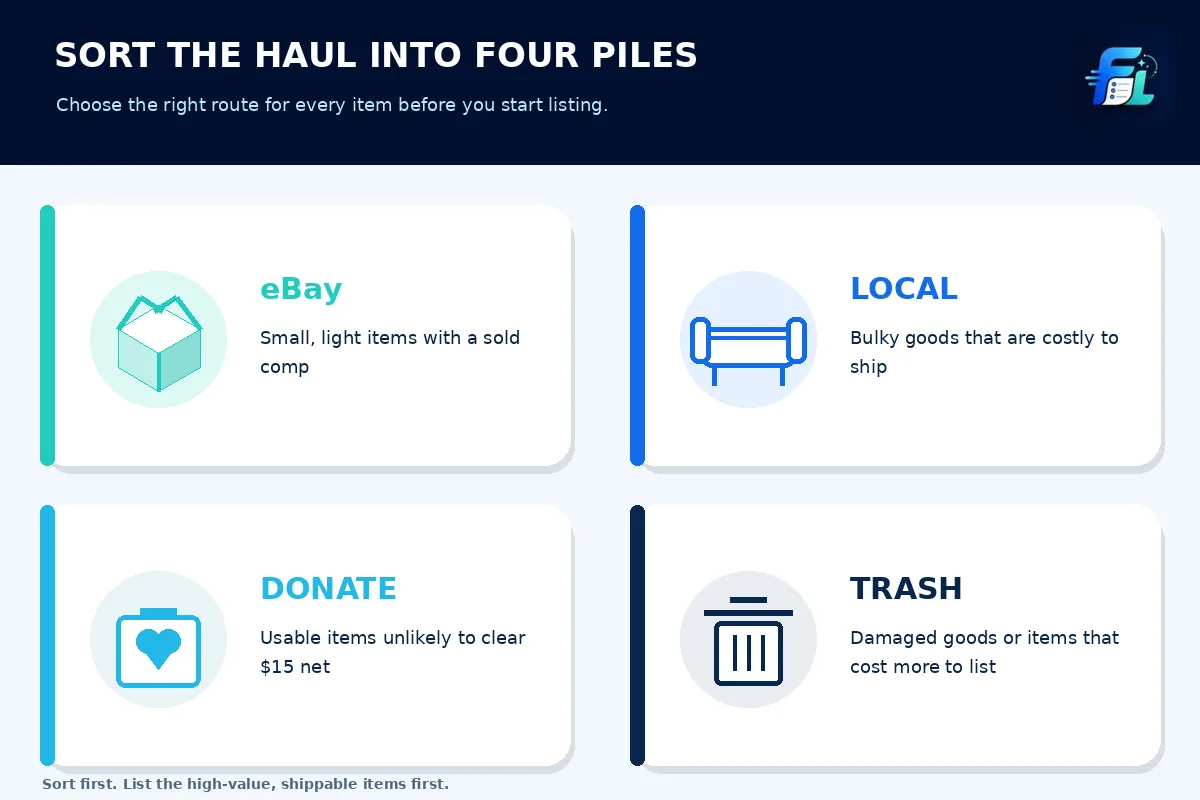
Sort into four piles the first day. Light, valuable items go to eBay. Heavy, low-value items go local, to donation or to the dump.
- eBay: Small, light, identifiable items with a sold comp.
- Local: Bulky furniture and anything where the label would eat the sale. FlowLister data shows a median $8.07 label on $27.02 Home & Garden sales.
- Donate: Usable goods that won't clear a $15 sale after fees and shipping.
- Trash: Damaged goods and anything you'd pay more to list than it earns.
Personal papers, photos and records aren't yours to sell. Auction terms often require you to turn them over to the facility. If you find a firearm, don't sell or keep it. Extra Space says to contact the facility and local authorities right away. Items that fail the label test are better sold locally.
What Sells Fastest From a Storage Unit
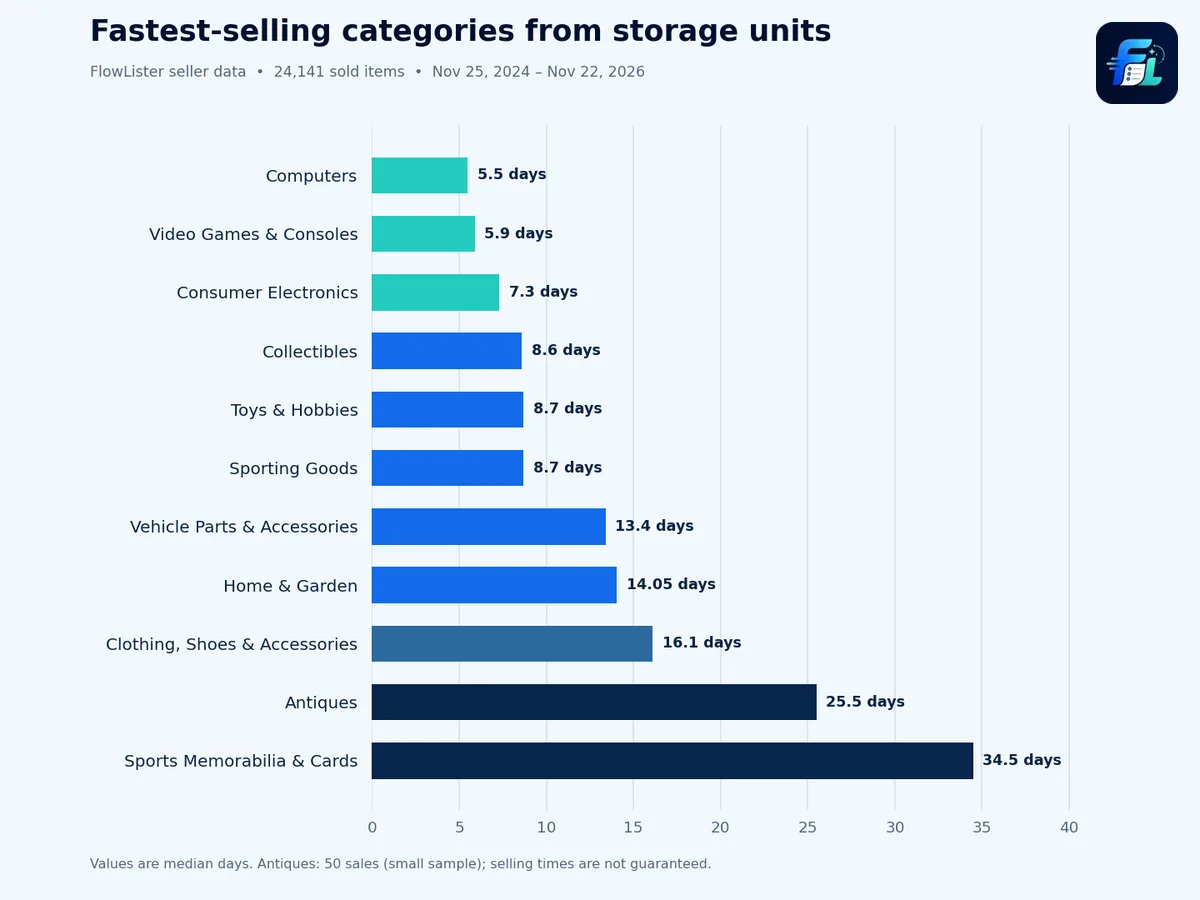
Electronics, games and computers turn into cash in about a week. Clothing is the volume. Cards and antiques sit.
Here's what 24,141 sold items looked like.
| Category | Sales | Median price | Median days to sell |
|---|---|---|---|
| Computers | 435 | $47.39 | 5.5 |
| Video Games & Consoles | 445 | $25.00 | 5.9 |
| Consumer Electronics | 368 | $39.99 | 7.3 |
| Collectibles | 2,018 | $18.00 | 8.6 |
| Toys & Hobbies | 1,140 | $24.99 | 8.7 |
| Sporting Goods | 619 | $28.79 | 8.7 |
| Vehicle Parts & Accessories | 1,187 | $29.69 | 13.4 |
| Home & Garden | 838 | $27.02 | 14.05 |
| Clothing, Shoes & Accessories | 7,408 (most of any category) | $20.00 | 16.1 |
| Antiques | 50 | $28.49 | 25.5 |
| Sports Memorabilia & Cards | 939 | $10.00 | 34.5 (slowest) |
Source: FlowLister sales data, 24,141 sold items, Nov 25, 2024 to Nov 22, 2026.
Pull computers, consoles and consumer electronics first. They sell in about a week, and computers and consumer electronics carry the two highest medians in the table. Clothing fills the long tail. Plan on weeks, not days. Treat antiques as a small sample, since only 50 sold.
What to List First
Use the table as your order of operations.
- Computers, consoles and electronics: Fastest cash. Test them and note what works.
- Toys, collectibles and sporting goods: Mid-speed, mid-price. List in batches.
- Clothing: Highest volume at a $20 median. Bundle photos and move fast.
- Cards and antiques: Slowest. List them last, or sell locally.
How I Sort a Haul
After an estate sale in Kingman, I sort the leftovers before listing anything. A Stihl 041 AV chainsaw, for example, earned a closer look because its exact model number gave me something specific to research against eBay sold listings.
I bundle unbranded linens and small décor, while bulky pieces such as pianos and grandfather clocks are better left for local buyers. Not every item belongs online.
How FlowLister Turns Unit Photos Into Listings
Photograph each item and FlowLister builds the listing from the photo. It writes the title and item specifics, then suggests a price from eBay sold comps when it finds a match.
- Photo to listing: Title, description, category, item specifics and price from your photos. Your typed notes override what the AI reads.
- Batch generation: Run a table of items in one pass instead of typing each one.
- Sold-comp pricing: It shows the matching sales and says so when no good comps exist.
- Crosslisting (paid add-on): Posts eBay listings to Poshmark and Mercari from your Chrome browser, and fills in Facebook Marketplace's listing form for you to publish (beta).
See the full feature list or try it for $0.99 for 7 days.
If you're listing a whole unit at once, our guide to bulk photo listing software for eBay shows how batch listing works.
FAQ
Can You Make Money on Storage Units?
Yes, but it isn't guaranteed. A unit sells as one lot, so you buy the valuable items and the junk together. Your profit depends on the winning bid, buyer fees, cleanout costs and how fast the good items sell, so run the unit math first.
What Happens to Personal Papers and Photos in a Unit?
You usually hand them back. Auction terms often require winners to return IDs, financial or medical records, legal documents and family photos to the facility. Don't keep, use or share private information you find, and read your auction's terms before you start sorting.
Are Online Storage Auctions Legit?
Yes, when you use established platforms that run real lien sales for real facilities. Read the auction terms, check the facility and add the buyer's premium to your math. A tenant can still pay the balance and cancel a sale before pickup.
Is It Like Storage Wars?
No. Real bidders can't step inside the unit or open boxes, and the lot sells as a whole. Winners usually have a day or two to clear everything. Extra Space says the reality often differs from what TV suggests.
Turn Your First Unit Into eBay Listings
A storage auction pays off when you treat it as a sourcing decision instead of a lottery. Three habits separate profitable buyers from frustrated ones. First, set your max bid before the auction starts and stop when the price passes it. Second, count every cost, including the buyer's premium, hauling, dump fees and your own hours. Third, sort the unit fast and list what sells quickest first, which in our sales data means computers, consoles and electronics.
We think the buyers who last are the boring ones. They skip the thrill of a bidding war and bid on the math. If you're learning how to buy storage units, a small unit with items you can price is a far better first step than a big mystery pile. Your first unit is practice for your second.
Keep a simple log of every unit: bid, fees, hours and net. After three units you'll know your real hourly rate, and that number tells you whether storage auctions deserve a spot in your sourcing plan.
When the unit is empty and the photos are taken, list your first three items with FlowLister's $0.99 trial and see how quickly photos turn into eBay listings.
Written by Chris Taylor, founder of FlowLister, who has sold on eBay since 2020.